
Homelab Setup: 2025 Year in Review
By Leonard Pahlke • 4 minutes read •
Homelab Setup: 2025 Year in Review
Before 2025, I worked primarily with my laptop and remote cloud instances. While these remain relevant, I began to wonder what the bare-metal layer below the cloud actually looked like. In 2025, I shifted my focus toward self-hosted, bare-metal infrastructure alongside my cloud work. This was driven by a curiosity to understand the physical layers of compute that are typically abstracted away in cloud environments. To build truly autonomous and decentralized systems, we must look at the entire stack again. Owning and understanding that stack is an interesting challenge.
This post is a wrap-up of the work I did throughout the year to better understand self-hosted hardware.
2025: Infrastructure & Prototyping
The early part of the year focused on hardware selection and rack integration. I began with getting my head around bare-metal topics, networking, and low-level topics like energy consumption—things you rarely consider in the cloud but which are essential to any IT infrastructure.
To start things off, you need hardware, so I did some research around self hosted systems. Eventually I selected Intel N100 mini-PCs as my primary compute nodes. There are many alternatives, but I was looking for an affordable x86 option that allowed me to buy multiple units to spin up a distributed system. Initially, I housed these in an old PC tower, but that proved inconvenient for swapping components. I eventually pivoted to a 10-inch “mini-rack” from DeskPi, which is an excellent option for experimentation. Its large enough to swap things out but small enough to carry it around with you.
Working with hardware is actually a lot of fun. Dealing with physical devices, heat, and cabling gives you a better sense of the tech you deploy on top; if your deployments are demanding, you can actually see and hear the impact. To take this further, I experimented with integrating IoT sensors (GPS, Ethernet, RTC) via Arduino Nanos. I also briefly tested WebAssembly (WASM) on a Raspberry Pi Pico, though the tooling felt too “bleeding edge” for reliable deployment at the time.
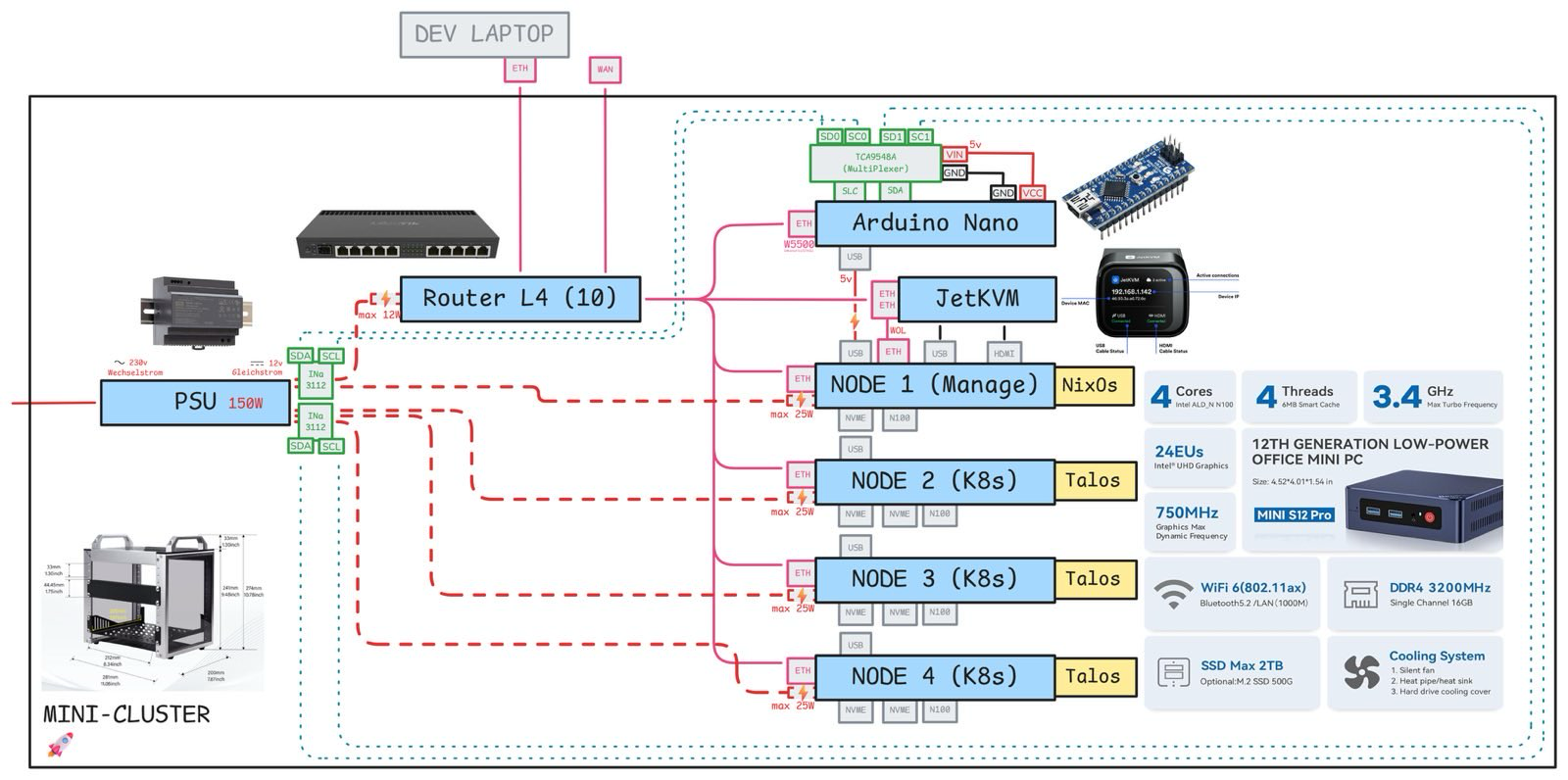
After the initial assembly, the plan evolved from simply housing servers to measuring energy consumption via INA-series IoT modules. While successful, the primary challenge was not technical, but physical: managing “cable spaghetti” within a small form factor rack is a pain. Ideally you want to eventually have this put on a board, but that’s a bit much, I suppose.
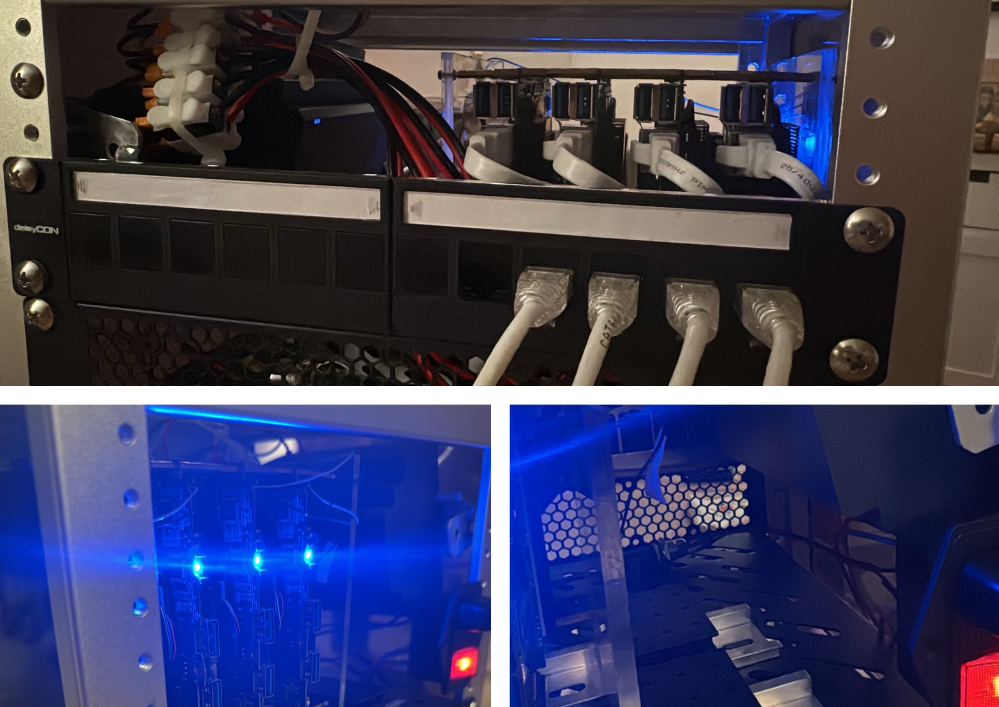
Currently, the IoT components function as standalone units. I have Arduinos for GPS, a real-time clock (RTC), energy relays, and energy sensors, but they are not yet fully integrated. As 2025 ends, I have set the IoT components aside to focus on integrating a custom, unified power supply to ensure the cluster is stable and functional.
2026 Roadmap
- Local AI Deployments: Hardware has caught up to local LLM requirements. I ordered an AMD Ryzen AI Max+ 395 (with 128 GB of unified memory) and plan to run high-parameter models like Mistral 70B locally using 8-bit quantization.
- Resilient Storage: In 2025 storage was not on top of my mind but is essential to infrastructure. I am wondering if a big S3 Blob that is perhaps managed by Garage can be the answer to data backup and storage.
- Programmable Infrastructure: Currently I am using an L3 switch that has services built in. However, instrumenting the switch might be interesting too. I have a Banana-Pi and am thinking about using it as a KVM/switch to programmatically manage power states and reintegrate the IoT sensor array.
- Physical Integration: Lastly, I am planning to finalize the mounting of IoT sensors into the chassis. Each sensor will be paired with a dedicated Arduino Nano and connected via USB, creating a modular, “plug-and-play” sensor cluster.